





The Asexual, or “Ace”, community may be statistically small but has a growing presence through online fellowship. In an effort to combat erasure and discrimination from without and within the LGBTQIA community, asexual people or “aces” have a rich culture of symbology and slang. While scholarship and scientific study on asexuality is very limited, bloggers and artists are increasingly creating a community of self-determination that does not see the need for others to explain for them their identities. The Asexual Visibility and Education Network AVEN was founded in 2001 and has provided greater awareness of the asexual community since its inception. In 2008, Acebook went live and began connecting the asexual community online. In 2011 the documentary film (A)sexual premiered exposing more outside of the Ace community to some of the basics of what asexuality looks like for some people. In 2013 the Huffington Postran a 6-article series on asexuality . The purpose of this page is to serve as a brief introduction to asexual identities and asexual culture and to list the above and more resources(found at the bottom) they are developing on the scene.
An asexual person is someone who does not experience sexual attraction. Most individuals find there are certain people they are not sexually attracted to. For asexual people, this includes everybody! Asexuality is not anti-sexuality. While it’s true that many asexual people never have sex, this is not the same thing as having a sex-negative attitude. Attitudes towards sex and its role in culture differ from person to person, just like they do outside the asexual community. Few asexual people express negative attitudes towards sex, but sex-negative attitudes are also present among non-asexual people. Most asexual people are open-minded in their attitudes toward sex regardless of their personal feelings towards it. Many asexual people consider themselves sex-positive.
According to the The Asexual Visibility and Education Network, AVEN: An asexual person is someone who does not experience sexual attraction. Unlike celibacy, which people choose, asexuality is an intrinsic part of who we are. Asexuality does not make our lives any worse or any better, we just face a different set of challenges than most sexual people. There is considerable diversity among the asexual community; each asexual person experiences things like relationships, attraction, and arousal somewhat differently. This site also includes some introductory definitions:
Asexual Person: Someone who does not experience sexual attraction.
Demisexual Person: Someone who can only experience sexual attraction after an emotional bond has been formed. This bond does not have to be romantic in nature.
Gray-asexual (Gray-a) or Gray-sexual Person: Someone who identifies with the area between asexuality and sexuality, for example because they experience sexual attraction very rarely, only under specific circumstances, or of an intensity so low that it’s ignorable.
Attraction: In this context, it refers to a mental or emotional force that draws people together. Asexuals do not experience sexual attraction, but some feel other types of attraction.
Aesthetic attraction: Attraction to someones appearance, without it being romantic or sexual.
Romantic attraction: Desire of being romantically involved with another person.
Sensual attraction: Desire to have physical non-sexual contact with someone else, like affectionate touching.
Sexual attraction: Desire to have sexual contact with someone else, to share our sexuality with them.
The Asexual Awareness Week OCTOBER 26-NOV1st
Asexual Culture/Visibilty:
Lingo:
“Ace”: a common slang term for asexual associated with the ace card symbol and the phonetic pronunciation of “asexual”
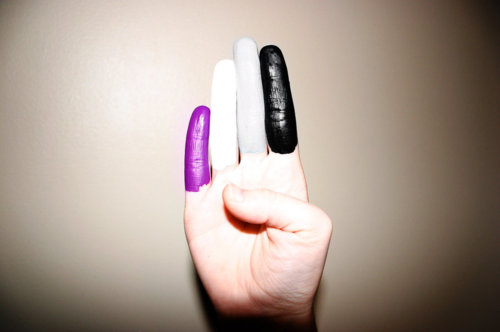
Flag: The Asexual Flag is purple white gray and black in ascending order Black: Asexuality Grey: Gray-A and demisexuality White: Sexuality Purple: Community

Symbols: Ace of Hearts/ Spades: “Ace is a popular nickname for a person who is asexual. It is a phonetic shortening of “asexual”, and has lead to some symbolism regarding the playing card “ace”. Some asexual people use the ace of spades or ace of hearts to represent their orientation. The ace of hearts is more commonly used for romantic asexual people, whereas an aromantic asexual person would generally use the spade.”

Cake: A symbol associated with asexuality inside of the community. Thought to be linked to the old proverbial choice between cake and sex because asexual folks would probably choose cake.

Equation: 53x+m³=Ø: this equation can be read as “sex + me = no result”
Black Ring: Some in the asexual community wear black rings, usually a middle finger and or left hand to signify their identity.

Discussion- Common Misconceptions about Asexuality:
Tory Butler: ” Some common misconceptions about asexuals are that there is something ‘wrong’ with them so they are not to be listened to. Many see asexuals as ‘special snowflakes’, as naive or innocent (as depicted in limited media spaces), as ‘broken’, or as having mental disorders. Asexuals can enjoy sex, be indifferent towards it, or be entirely sex-repulsed and this depends on the individual at hand. Asexuals can masturbate, tell dirty jokes, be in romantic relationships, and still be asexual. Gray-asexual and demisexual identities can be understood as when an individual creates a strong emotional bond with someone they can feel sexual attraction for them, but not experience sexual attraction otherwise. An adult understanding of the sexual and nonsexual world and asexuality are not mutually exclusive. The idea that asexuals are immature or innocent and will ‘grow’ to ‘understand’ and be sexual is misguided.”
Nathan Kelly: “When some people hear that some asexuals aren’t interested in sex, it’s perceived as ‘not wanting sex with you’ instead of ‘not sexually attracted to you at all.’ In our society, especially for asexual women, this is seen as being ‘prudish’, because of that fundamental misunderstanding. Many aces are sex-positive in general, and some do have sex. Of course, there is also the usual response one gets when discussing queer sexualities; that asexual people “just haven’t found the right man/woman, yet.” This presumes that aces are waiting for someone to complete some ‘missing’ aspect of their lives.”
Kelly Hassan: “There is a misconception that all people who identify as asexual, or on the asexual spectrum, do so because they are victims of sexual violence. It is true that some may be survivors of sexual violence, but many sexual people may be as well. The important thing is to accept asexuality as an identity, just like any other, and to take the time to learn what it means to the individual. When you do that, you can begin to better understand and see the diversity within the asexual community.”
Resource Guide:
AVEN the Asexual Visibility and Education Network Is the largest online organization and educator about Asexuality and also hosts chat and forum communities for members.
Asexuality Archive Is an online information hub “a collection of all things Ace”.
Acebook Is an online community for people who identify as Asexual to find friends and relationships.
Asexual Awareness Week Is an organization that hosts a week to promote awareness about the Asexual community October 26-Nov 1st (2014) See the site to participate and watch cute videos.
Huffington Post In 2013 Huff Po’s Dominique Mosbergen published a 6-article series on asexuality . These articles included:
- What is Asexuality – A Community’s Coming of Age
- Asexual Disorder? The Search For Ace Identity Is Part Recognition, Part Redefinition
- Asexual Relationships, Masturbation And Romance In The Ace Community
- Battling Asexual Discrimination, Sexual Violence And ‘Corrective’ Rape
- LGBT, Asexual Communities Clash Over Ace Inclusion
- Asexual Community Leaders Look Toward The Future
Film: (A)sexual (2011) was directed by Angela Tucker The IMDB description of this film reads “Facing a sex obsessed culture, a mountain of stereotypes and misconceptions, and a lack of social or scientific research, asexuals – people who experience no sexual attraction – struggle to claim their identity”
Isabel Williams is a 2014 Summer Fellow at Campus Pride. She is a rising senior at the College of Charleston studying Political Science. Isabel is the Student Organizer for College of Charleston’s SafeZone program and the president of the Gay-Straight Alliance. Learn more about Isabel